
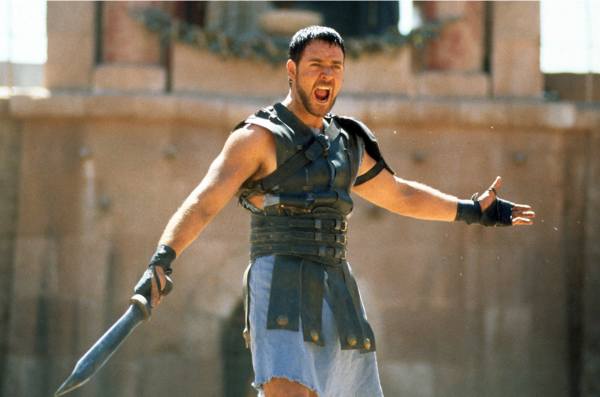
Starring: Russell Crowe, Joaquin Phoenix, Connie Nielsen, Oliver Reed, Richard Harris, Derek Jacobi, Djimon Hounsou, David Schofield, John Shrapnel, Tomas Arana, Ralf Moeller, Spencer Treat Clark, David Hemmings
OUR RATING: ★★★★★
Story:
Epic historical drama directed by Ridley Scott. Set in Roman times, Gladiator follows Maximus (Russell Crowe), a powerful Roman general, loved by the people and the aging Emperor, Marcus Aurelius (Richard Harris). However, before his death, the Emperor chooses Maximus to be his heir over his own son, Commodus (Joaquin Phoenix), which causes a power struggle, leaving Maximus and his family condemned to death. After being unable to save his family, Maximum is sold into slavery to be trained as a gladiator. The only desire that fuels him now is the chance to rise to the top so that he will be able to look into the eyes of the man who will feel his revenge.
Our Favorite Quotes:
‘What we do in life echoes in eternity.’ – Maximus (Gladiator) Share on X
Best Quotes
Maximus: Lean and hungry. Still nothing?
Quintus: Not a sign.
Maximus: How long has he been gone?
Quintus: Nearly two hours.
Valerius: Will they fight sir?
Maximus: We shall know soon enough.
Quintus: People should know when they are conquered.
Maximus: Would you, Quintus? Would I?
Maximus: [to Quintus] Strength and Honor.
Maximus: [addressing his troops] Three weeks from now, I will be harvesting my crops. Imagine where you will be, and it will be so. Hold the line! Stay with me! If you find yourself alone, riding in the green fields with the sun on your face, do not be troubled. For you are in Elysium, and you’re already dead!
Maximus: Brothers, what we do in life echoes in eternity.
‘When a man sees his end, he wants to know there was some purpose to his life.’ - Marcus Aurelius (Gladiator) Share on X
Commodus: [referring to their father Marcus Aurelius] Do you think he’s really dying?
Lucilla: He’s been dying for ten years.
Commodus: He’s made his decision. He’s going to announce it. He will name me. The first thing I shall do, well, is honor him with games worthy of his majesty.
Lucilla: For now, the first thing I shall do is have a hot bath.
Marcus Aurelius: You have proved your valor, yet again Maximus. Let us hope for the last time.
Maximus: There is no one left to fight, sire.
Marcus Aurelius: There is always someone left to fight. How can I reward Rome’s greatest general?
Maximus: Let me go home.
Marcus Aurelius: Ah, home.
Commodus: Have I missed it? Have I missed the battle?
Marcus Aurelius: You have missed the war.
Commodus: Father, congratulations. I shall sacrifice a hundred bulls to honor your triumph.
Marcus Aurelius: Save the bulls. Honor Maximus. He won the battle.
Quintus: Maximus the farmer. I still have difficulty imagining that.
Maximus: You know dirt cleans off a lot easier than blood Quintus.
‘I knew a man who once said, “Death smiles at us all. All a man can do is smile back.”’ – Maximus (Gladiator) Share on X
Maximus: Highness, when your father releases me I intend to return home
Commodus: Well, no one has earned it more. Don’t get too comfortable, I may call on you before long.
Marcus Aurelius: [seeing Lucilla spying through the slit in the tent wall] If only you had been born a man, what a Caesar you would have made.
Lucilla: Father.
Marcus Aurelius: You would have been strong. I wonder, would you have been just?
Lucilla: I would have been what you taught me to be.
Marcus Aurelius: Enough of politics. Let us pretend that you are a loving daughter, and I am a good father.
Lucilla: This is a pleasant fiction, isn’t it?
Marcus Aurelius: Tell me again, Maximus, why are we here?
Maximus: For the glory of the Empire, sire.
Maximus: Five thousand of my men are out there in the freezing mud. Three thousand of them are bloodied and cleaved. Two thousand will never leave this place. I will not believe that they fought and died for nothing.
Marcus Aurelius: And what would you believe?
Maximus: They fought for you and for Rome.
Marcus Aurelius: And what is Rome, Maximus?
Maximus: I’ve seen much of the rest of the world. It is brutal and cruel and dark, Rome is the light.
Marcus Aurelius: Yet you have never been there. You have not seen what it has become. I am dying, Maximus. When a man sees his end, he wants to know there was some purpose to his life. How will the world speak my name in years to come? Will I be known as the philosopher? The warrior? The tyrant? Or will I be the emperor who gave Rome back her true self? There was once a dream that was Rome. You could only whisper it. Anything more than a whisper and it would vanish, it was so fragile. And I fear that it will not survive the winter. Maximus, let us whisper now, together you and I. You have a son? Tell me about your home.
'Are you not entertained?! Are you not entertained?! Is this not why you are here?' - Maximus (Gladiator) Share on X
Marcus Aurelius: When was the last time you were home?
Maximus: Two years, two hundred and sixty-four days and this morning.
Marcus Aurelius: There is one more duty that I ask of you before you go home.
Maximus: What would you have me do Caesar?
Marcus Aurelius: I want you to become the protector of Rome after I die. I will empower you to one end alone, to give power back to the people of Rome and end the corruption that has crippled it. Do you accept this great honor that I have offered you?
Maximus: With all my heart, no.
Marcus Aurelius: Maximus, that is why it must be you.
Marcus Aurelius: [to Maximus] Commodus is not a moral man. You have known that since you were young. Commodus cannot rule. He must not rule. You’re the son that I should have had. Commodus will accept my decision. He knows that you command the loyalty of the army.
Lucilla: My father favors you now.
Maximus: My Lady.
Lucilla: It was not always so.
Maximus: Many things change.
Lucilla: Many things, not everything.
Lucilla: What did my father want with you?
Maximus: To wish me well before I leave for home.
Lucilla: You’re lying, I could always tell when you were lying because you were never any good at it.
Maximus: I never acquired your comfort with it.
Lucilla: True, but then you never had to, life is more simple for a soldier. Or do you think me heartless?
Maximus: I think you have a talent for survival.
'Ultimately, we're all dead men. Sadly, we cannot choose how, but we can decide how we meet that end, in order that we are remembered as men.' - Proximo (Gladiator) Share on X
Maximus: [praying] Ancestors, I ask you for your guidance. Blessed mother, come to me with the Gods’ desire for my future. Blessed father, watch over my wife and son with a ready sword. Whisper to them that I live only to hold them again. Ancestors, I honor you and will try to live with the dignity that you have taught me.
Maximus: Do you find it hard to do your duty?
Cicero: Sometimes I do what I want to do. The rest of the time, I do what I have to.
Marcus Aurelius: Are you ready to do your duty for Rome?
Commodus: Yes, father.
Marcus Aurelius: You will not be emperor.
Commodus: Which wiser, older man is to take my place?
Marcus Aurelius: My powers will pass to Maximus, to hold in trust until the Senate is ready to rule once more. Rome is to be a republic again.
Commodus: Maximus?
Marcus Aurelius: Yes. My decision disappoints you?
Commodus: You wrote to me once, listing the four chief virtues: Wisdom, justice, fortitude and temperance. As I read the list, I knew I had none of them. But I have other virtues, father. Ambition. That can be a virtue when it drives us to excel. Resourcefulness, courage, perhaps not on the battlefield, but there are many forms of courage. Devotion, to my family, to you. But none of my virtues were on your list. Even then it was as if you didn’t want me for your son.
Marcus Aurelius: Oh, Commodus. You go too far.
Commodus: I search the faces of the gods for ways to please you, to make you proud. One kind word, one full hug, where you pressed me to your chest and held me tight. Would have been like the sun on my heart for a thousand years. What is it in me that you hate so much?
Marcus Aurelius: Shh, Commodus.
Commodus: All I’ve ever wanted was to live up to you, Caesar. Father.
Marcus Aurelius: Commodus, your faults as a son is my failure as a father. Come.
Commodus: [holds his arms out to Commodus and they embrace] Father. I would have butchered the whole world, if you would only love me!
[Commodus begins to asphyxiate Marcus whilst embracing him]
Commodus: [as Maximus sees the dead body of Marcus Aurelius] Your Emperor asks for your loyalty, Maximus. Take my hand, I only offer it once.
'Imagine where you will be, and it will be so.' - Maximus (Gladiator) Share on X
Quintus: Maximus, please be careful, that was not prudent.
Maximus: Prudent! The Emperor has been slain.
Maximus: Quintus, look at me. Look at me! Promise me that you’ll look after my family.
Quintus: Your family will meet you in the afterlife.
Maximus: [to the guard, referring to the sword] The frost, sometimes it makes the blade stick.
[Maximus then swings the sword at the guard, cutting him across the face and killing him]
Maximus: Blessed father, watch over my wife and son with a ready sword. Whisper to them that I live only to hold them again, for all else is dust and air.
Juba: [to Maximus who has been captured] Don’t die. They’ll feed you to the lions. They are worth more than we are.
'At my signal, unleash Hell.' - Maximus (Gladiator) Share on X
Proximo: [grabs hold of the slave trader’s crotch] Those giraffes you sold me, they won’t mate. They just walk around eating, not mating. You sold me queer giraffes. I want my money back.
Slave Trader: Not a chance. I’ll do a special price for you!
Proximo: [referring to the slaves] Do any of them fight? I’ve got a match coming up.
Slave Trader: Some are good for fighting, others for dying. You need both, I think.
Proximo: [addressing his new slave recruits] I am Proximo. I shall be closer to you for the next few days, which will be the last of your miserable lives, than the bitch of a mother that brought you screaming into this world. I did not pay good money for you for your company, I paid it so that I could profit from your death and as your mother was there at your beginning, so I shall be there at your end. And when you die, and die you shall, your transition shall be to the sound of…
Proximo: [claps his hands] Gladiators, I salute you.
Proximo: [to the gladiators, the crowd can be heard stamping their feet, cheering] Some of you are thinking you won’t fight, some that you can’t. They all say that until they are out there. Listen.
Proximo: [referring to the sword] Thrust this into another man’s flesh and they will applaud and love you for that. You may begin to love them for that. Ultimately, we’re all dead men. Sadly, we cannot choose how, but we can decide how we meet that end, in order that we are remembered as men.
Gracchus: [referring to Commodus] He enters Rome like a conquering hero. What has he conquered?
Falco: Give him time. He’s young. I think he could do very well.
Gracchus: For Rome or for you?
Gracchus: But the Senate is the people, Sire, chosen from among the people, to speak for the people.
Commodus: I doubt if many of the people eat so well as you do, Gracchus, or have such splendid mistresses Gaius. I think I understand my own people.
Gracchus: Then perhaps Caesar would be so good as to teach us, out of his own extensive experience.
Commodus: I call it love. I am their father, the people are my children, and I shall hold them to my bosom, and embrace them tightly.
Gracchus: Have you ever embraced someone dying of plague, Sire?
Commodus: No. But if you interrupt me again, I assure you that you shall.
Maximus: [to the crowd] Are you not entertained?! Are you not entertained?! Is this not why you are here?
Crowd: Spaniard, Spaniard, Spaniard…
Proximo: What do you want? Hmm? Girl? Boy?
Maximus: You sent for me?
Proximo: Yes I did. You are good, Spaniard, but you’re not that good. You could be magnificent.
Maximus: I am required to kill so I kill. That is enough.
Proximo: That’s enough for the provinces, but not for Rome.
Proximo: The young Emperor has arranged a series of spectacles to commemorate his father, Marcus Aurelius. I find that amusing since it was Marcus Aurelius, the wise, the all-knowing Marcus Aurelius, who closed us down. So finally after five years of scratching a living in flea infested villages we are finally going back to where we belong, the Colosseum. Oh you should see the Colosseum, Spaniard. Fifty thousand Romans watching every movement of your sword, willing you to make that killer blow. The silence before you strike, and the noise afterwards, it rises, rises like, like a storm, as if you were the Thunder God himself.
Maximus: [laughs] You knew Marcus Aurelius?
Proximo: I did not say I knew him. I said he touched me on the shoulder once!
Proximo: Then listen to me. Learn from me. I wasn’t the best because I killed quickly. I was the best because the crowd loved me. Win the crowd and you’ll win your freedom.
Maximus: I will win the crowd. I will give them something they have never seen before.
Proximo: Ha! So, Spaniard, we shall go to Rome together and have bloody adventures and the great whore will suckle us until we are fat and happy and can suckle no more. And then, when enough men have died, perhaps you will have your freedom.
Juba: It’s somewhere out there, my country, my home. My wife is preparing food. My daughter is carrying water from the river. Will I ever see them again? I think not.
Maximus: Do you believe that you will see them again when you die?
Juba: I think so, but then, I will die soon. They will not die for many years. I’ll have to wait.
Maximus: But you would wait?
Juba: Of course.
Maximus: You see, my wife and my son are already waiting for me.
Juba: You will meet them again. But not yet. Not yet.
Maximus: Not yet. Not yet.
Juba: [referring to the Colosseum] I didn’t know men could build such things.
Commodus: Will you stay with me?
Lucilla: Still afraid of the dark, brother?
Commodus: Still? Always. Stay with me tonight?
Lucilla: You know I won’t.
Commodus: Then kiss me.
Lucilla: [kisses his forehead] Sleep, brother.
Proximo: If you want to give away the best gladiators in the whole of the empire, I want double the rates.
Cassius: You will get your contract rates or you will get your contract cancelled. If you don’t like it, then you can crawl back down that shit hole that you came from.
Lucius: Gladiator, are you the one they call the Spaniard?
Maximus: Yes.
Lucius: They said you were a giant. They said you can crush a man’s skull with one hand.
Maximus: [teasingly] Man’s? No. A boy’s…
Lucius: I like you Spaniard. I shall cheer for you.
Maximus: They let you watch the games?
Lucius: My uncle says it makes me strong.
Maximus: And what does your father say?
Lucius: My father’s dead.
Servant: Master Lucius, it is time.
Lucius: I have to go.
Maximus: Your name is Lucius?
Lucius: Lucius Verus, after my father.
Commodus: [as Proximo’s gladiators win the battle in the Colosseum] My history’s a little hazy Cassius, but shouldn’t the Barbarians lose the battle of Carthage!!
Cassius: Uh, yes, Sire. Forgive me, Sire.
Commodus: [to Maximus] Your fame is well deserved, Spaniard. I don’t think there’s ever been a gladiator to match you. As for this young man, he insists you are Hector reborn. Or was it Hercules? Why doesn’t the hero reveal himself and tell us all your real name? You do have a name?
Maximus: My name is Gladiator.
Commodus: [as Maximus turns away from him] How dare you show your back to me! Slave, you will remove your helmet and tell me your name.
Maximus: [removes his helmet and turns] My name is Maximus Decimus Meridius. Commander of the Armies of the North, General of the Felix Legions, loyal servant to the true emperor, Marcus Aurelius. Father to a murdered son, husband to a murdered wife. And I will have my vengeance, in this life or the next.
Commodus: Why is he still alive?
Lucilla: I don’t know.
Commodus: He shouldn’t be alive. It vexes me. I am terribly vexed.
Commodus: What did you feel when you saw him?
Lucilla: I felt nothing.
Commodus: He wounded you deeply, didn’t he?
Lucilla: No more than I wounded him.
Lucilla: Rich matrons pay well to be pleasured by the bravest champions.
Maximus: I knew your brother would send assassins. I didn’t realize he would send his best.
Lucilla: Maximus, he doesn’t know.
Maximus: My family was burned and crucified while they were still alive.
Lucilla: I knew nothing about it.
Maximus: Don’t lie to me!
Lucilla: I wept for them.
Maximus: [grabs her throat] As you wept for your father? As you wept for your father?
Lucilla: I have been living in a prison of fear since that day. To be unable to mourn your father for fear of your brother. To live in terror every moment of every day, because your son is heir to the throne. Oh, I have wept.
Maximus: My son was innocent.
Lucilla: So is mine. Must my son die too before you’ll trust me?
[Maximus releases his hold on her throat]
Lucilla: There are some politicians who have dedicated their lives to Rome. One man above all. If I can arrange it, will you meet him?
Maximus: Do you not understand? I may die in this cell tonight or in the arena tomorrow. I am a slave! What possible difference can I make?
Lucilla: This man wants what you want.
Maximus: Then have him kill Commodus!
Lucilla: I knew a man once. A noble man. A man of principle, who loved my father and my father loved him. This man served Rome well.
Maximus: That man is gone. Your brother did his work well.
Lucilla: Let me help you.
Maximus: Yes. You can help me. Forget you ever knew me. Never come here again. Guard! The lady has finished with me.
Juba: [to Maximus] You have a great name. He must kill your name before he kills you.
Falco: Senator Gracchus. Don’t often see you enjoying the pleasures of the vulgar crowd.
Gracchus: I do not pretend to be a man of the people, Senator. But I do try to be a man for the people.
Proximo: He knows too well how to manipulate the mob.
Maximus: Marcus Aurelius had a dream that was Rome, Proximo. This is not it. This is not it!
Proximo: Marcus Aurelius is dead Maximus. We mortals are but shadows and dust. Shadows and dust, Maximus.
Tigris: [before he begins his battle with Maximus] We who are about to die salute you.
Commodus: What am I going to do with you, you simply won’t die. Are we so different, you and I? You take life when you have to, as I do.
Maximus: I have only one more life to take, then it is done.
Commodus: Take it now.
Commodus: They tell me your son squealed like a girl when they nailed him to the cross. And your wife, moaned like a whore when they ravaged her again, and again, and again.
Maximus: The time for honoring yourself will soon be at an end. Highness.
Juba: [as Maximus kisses the figurines of his wife and son] Can they hear you?
Maximus: Who?
Juba: Your family, in the afterlife?
Maximus: Oh, yes.
Juba: What do you say to them ?
Maximus: To my boy, I tell him I will see him again soon, to keep his heels down when he’s riding his horse. To my wife, that is not your business.
[they both laugh]
Commodus: And now they love Maximus for his mercy. So I can’t just kill him, or it makes me even more unmerciful! The whole thing’s like some crazed nightmare.
Falco: He is defying you. His every victory is an act of defiance. The mob sees this, and so do the Senate. Every day he lives, they grow bolder. Kill him.
Commodus: No. I will not make a martyr of him.
Falco: I have been told of a certain sea snake which has a very unusual method of attracting its prey. It will lie at the bottom of the ocean as if wounded. Then its enemies will approach, and yet it will lie quite still. And then its enemies will take little bites of it, and yet it remains still.
Commodus: So, we will lie still, and let our enemies come to us and nibble. Have every senator followed.
Gracchus: General. I hope my coming here today is evidence enough that you can trust me.
Maximus: The Senate is with you?
Gracchus: The Senate? Yes, I can speak for them.
Maximus: You can buy my freedom and smuggle me out of Rome?
Gracchus: To what end?
Maximus: Get me outside the city walls. Have fresh horses ready to take me to Ostia. My army is in camp there. By nightfall of the second day I shall return at the head of 5,000 men.
Lucilla: But the legion all have new commanders, Loyal to Commodus.
Maximus: Let my men see me alive and you shall see where their loyalties lie.
Gracchus: This is madness. No Roman army has entered the capital in a hundred years. I will not trade one dictatorship for another.
Maximus: The time for half measures and talk is over, Senator.
Gracchus: And after your glorious coup, what then? You’ll take your five thousand warriors and leave?
Maximus: I will leave. The soldiers will stay for your protection, under the command of the Senate.
Gracchus: So, once all of Rome is yours, you’ll just give it back to the people. Tell me why?
Maximus: Because that was the last wish of a dying man. I will kill Commodus, the fate of Rome, I leave to you.
Gracchus: Marcus Aurelius trusted you. His daughter trusts you. I will trust you. But we have little time. Give me two days and I will buy your freedom. And you, you stay alive. Or I will be dead. Now I must go.
Proximo: It won’t work. The emperor knows too much. And as for me, it’s becoming dangerous.
Maximus: You will be paid on my return. I give you my word.
Proximo: Your word! What if you don’t return?
Maximus: Do you remember what it was to have trust, Proximo?
Proximo: Trust? Who am I to trust?
Maximus: I will kill Commodus.
Proximo: Why do I want that. He makes me rich. Oh, I know that you are a man of your word, General. I know that you would die for honor. You would die for Rome. You would die for the memory of your ancestors. But I on the other hand, I am an entertainer. Guard!
Maximus: He killed the man who set you free.
Commodus: Do you remember what our father said once? It’s a dream, a frightful dream, life is. Do you think that’s true?
Lucilla: I don’t know.
Commodus: I think it is. And I have only you to share it with.
Proximo: [brings Lucilla to Maximus’ cell] Congratulations, General. You’ve got very persuasive friends.
Lucilla: My brother’s had Gracchus arrested. We daren’t wait any longer. We must leave tonight. Proximo will come at midnight and take you to the gate. Your servant, Cicero will be waiting there with horses.
Maximus: You have done all this?
Lucilla: Yes.
Maximus: You risk too much.
Lucilla: I have much to pay for.
Maximus: You have nothing to pay for. You love your son, you are strong for him.
Lucilla: I am tired of being strong. My brother hates all the world and you most of all.
Maximus: Because your father chose me.
Lucilla: No, because my father loved you, and because I loved you.
Maximus: A long time ago.
Lucilla: Was I very different then?
Maximus: You laughed more.
Lucilla: I have felt alone all my life, except with you. I must go.
Maximus: Yes.
[they exchange a long tender kiss]
Commodus: [as Lucilla finds Commodus talking to Lucius] And just wait until you hear what happened to our ancestors! If you’re very good, tomorrow night I’ll tell you the story of Emperor Claudius. He was betrayed, by those closest to him, by his own blood, they whispered in dark corners and went out late at night and conspired and conspired. But the Emperor Claudius knew that they were up to something. He knew they were busy little bees. And one night he sat down with one of them and he looked at her and he said, “Tell me what you have been doing, busy little bee, or I shall strike down those dearest to you. You shall watch as I bathe in their blood.” And the emperor was heartbroken. The little bee had wounded him more deeply than anyone else could ever had done. And what do you think happened then, Lucius?
Lucius: I don’t know Uncle.
Commodus: [looking at Lucilla] The little bee told him everything.
Proximo: Here. Everything is prepared. It seems you have won your freedom.
Maximus: Proximo, are you in danger of becoming a good man.
Proximo: Hah!
Proximo: [just before he’s killed] Shadows and dust.
Commodus: [to Falco] And what of my nephew and what of his mother? Should they share her lover’s fate or should I be merciful? Commodus the merciful. Lucius will stay with me now and if his mother so much as looks at me in a manner that displeases me, he will die.
Commodus: [turns to Lucilla] If she decides to be noble and take her own life, he will die. And, as for you, you will love me as I loved you. You will provide me with an heir of pure blood so that Commodus and his progeny will rule for a thousand years. Am I not merciful? Am I not merciful?!
Commodus: [to the chained Maximus] Maximus. Maximus. Maximus. They call for you. The general who became a slave. The slave who became a gladiator. The gladiator who defied an emperor. A striking story. Now the people want to know how the story ends. Only a famous death will do. And what could be more glorious than to challenge the emperor himself in the great arena.
Maximus: You would fight me?
Commodus: Why not? Do you think I am afraid?
Maximus: I think you have been afraid all your life.
Commodus: Unlike Maximus the invincible, who knows no fear?
Maximus: [laughs] I knew a man who once said, “Death smiles at us all. All a man can do is smile back.”
Commodus: I wonder. Did your friend smile at his own death?
Maximus: You must know. He was your father.
Commodus: You loved my father, I know. But so did I. That makes us brothers, doesn’t it? Smile for me now, brother.
Commodus: [embraces Maximus and stabs him where no one can see, to Quintus] Strap on his armor. Conceal the wound.
Commodus: [during the fight with Maximus] Quintus, sword! Give me your sword!
Commodus: [to his guards] Sword, give me a sword!
Quintus: Sheathe your swords! Sheathe your swords!
Maximus: [after killing Commodus] Quintus, free my men. Senator Gracchus is to be reinstated. There was a dream that was Rome, it shall be realized. These are the wishes of Marcus Aurelius.
Maximus: [to Lucilla] Lucius is safe.
Lucilla: [to Senator Gracchus and the crowd in the Colosseum] Is Rome worth one good man’s life? We believed it once. Make us believe it again. He was a soldier of Rome. Honor him.
Gracchus: Who will help me carry him?
Juba: [buries Maximus’s figurines where he died] Now we are free. I will see you again. But not yet, not yet.
Trailer: