
Review By Samuel Maguire (Manchester)
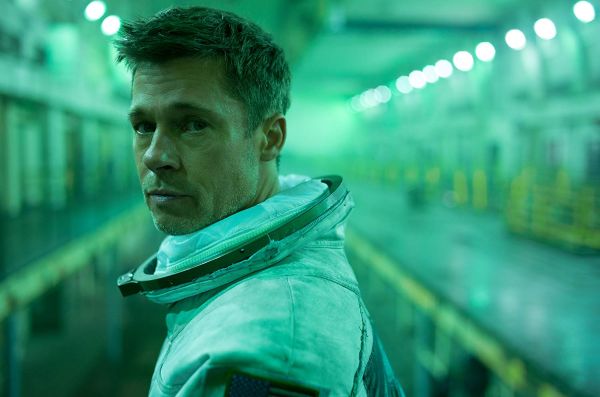
A Sleek Mediation Between Space Spectacle and Family Sentiment
Ad Astra is a film of high pretensions, lofty ambition and some imagination, making it at the very least noteworthy in the bravery and flair.
Pitt’s Roy McBride is the latest man flung through time and space, following luminaries from 2001, Gravity and of course Interstellar. But it is Apocalypse Now that most closely reassembles the journey McBride finds himself in. Having been charged with the investigation of the mysterious Lima Project once led by his decorated father – McBride Senior – Roy is forced to revisit his past as he first hurtles through space. Director James Grey imagines space less of a wild west frontier and more of an already semi colonised outpost of mankind. He in particular, takes great pleasure in presenting the moon as an already commercialised fortress, albeit one fraught with petty banditry and piracy. The human codes of life have only been tentatively established, and facilities in deep space ran by conglomerates have only been half civilized. As McBride journeys beyond the thick air of corporate paranoia and greed cling to the screen.
With the spectacular backdrop of the wonderful black canvas of space, Pitt provides a very Captain Willard-esque narration, musing and recalling his relationship with his distant father in Malick like mystique.
It is this relationship between provocative imagery with awesome staying power and philosophical dialogue that underpins Ad Astra.
It quickly becomes clear the film is thematically hinting at some kind of family showdown, in which the fate of mankind is intertwined with Pitt’s particular brand of absent father syndrome. The result is a perpetual balancing act between awesome visual spectacle, wonderfully captured by Hoyte van Hoytema and family drama, but this time set in deep space.
On occasion, this is an arrangement that sags and strains against the film’s excesses. And there are excesses. The running time for one is too long, clocking in around 20 minutes too long and the film’s slow meditative pace does not quite fully rouse itself for a wholly satisfying finale. The threads the film has been weaving together are not tied in in a way that is complimentary to the preceding two acts. Spectacle is used too often where sentiment should have prevailed and in the final 30 minutes the two forces swap positions.
This flaw holds no origin from the actors. Pitt is reliable, convincing and intense, the film makes a great deal over his heart rate having never exceeded 80 beats per minute even when subjected to the most pressurised situations space has to offer and Pitt’s unruffled demeanour makes this credible.
Jones for much of the film is more of an abstract, a representation of Pitt’s deeply held trauma. He is the Commander Kurtz of space, surely waiting in the dark for the return of his prodigal son. But when Jones does arrive, he provides a sense of reliable gravitas that his casting would suggest. The craggy old face, almost ape like in some shots, is convincing as the face of a man who has surely spent years on solitude in an anonymous pocket of space.
There is a certain sense of gravitas, macabre awe and sheer weight of occasion with Ad Astra, but it remains restrained, permitted to flow naturally rather than to become overpowering. Combined with a mesmeric score, Ad Astra reminded me in many ways of an opera piece, possessing the same regal elegance and cinematic pedigree.
For the most part, the moments of violence which punctuate the film’s eerie ambience are quickly moved on from and the ballet like pulsations return. The film’s union between patient, methodical and atmospheric storytelling and its episodic violence plays out uneasily. And when the film approaches the climax this tension notably ruptures, with Ad Astra caught between persisting with its thoughtful space melody and becoming increasingly aware it may need an injection of visceral intensity to conclude a whole lot of naval gazing and stakes building.
When it becomes clear Ad Astra cannot wrap up all of the threads it has been weaving it is hard not to come away with a sense of lingering disappointment. Ad Astra is the work of someone who deeply loves cinema and there are more than just moments here when we see visual splendour in lieu with efficient storytelling.
Rating: 3/5
thanks to MQM Webmaster, the quotes its beautiful
I’d love to see the quote by Roy after the ship’s captain is killed by the babboons ‘we are here and then we are gone etc.’ I have been thinking about impermance a lot lately and that really hit home.
as above
Roy McBride: I am on my way to Mars. We answered a mayday call, and ended in tragedy. We lost the Captain.
Automated Voice: Your answer is being processed. Please continue.
Roy McBride: Well, that’s it. I mean, we go to work, we do our jobs, and then it’s over. We’re here, and then we’re gone.
Automated Voice: Please describe how the incident itself affected you.
Two quotes I’d like to get verbatim are:
1. the Moon base commander (?) explaining that the Moon is divided into national zones.
2. Roy saying how we went to space to explore and ended up making it just like home.
Does anyone remember the quote he says about solitude at the end? I’m not sure if I remember it correctly but it was one of my favorites of the movie.
“i await the day my solitude ends and i am home”
As above:
Automated Voice: Trajectory, Earth. two point seven one four billion miles.
Roy McBride: I am looking forward to the day my solitude ends, and I’m home.
Automated Voice: Destination is T minus twenty seconds.
There’s a quote when Roy just landed on Moon and he said something about human’s problem and that they never actually solved them, they just bring them to the Moon.
Does anyone notice that quote?
Maybe:
Display Message: Earth’s Moon: When the world comes together.
Second Display Message: WELCOME TO The Moon
Voice Over: All hopes we ever had for space travel covered up by drink stands and T-Shirt vendors. Just a recreation of what we are running from on earth. We are world leaders. If my dad could see this now, he’d tear it all down.
What is the quote in the fi scene about purpose?
I remember a quote about loneliness when Roy is on way to Neptune. Anyone have it ?
Was there a quote by Roy in the movie where he says ” I’m mission ready” ?
[Getting ready to head to the moon]
Roy McBride: Resting BPM is fifty-six. I didn’t sleep much last night. Shouldn’t be a problem. I remain mission ready.
Automated Voice: You have been approved for lunar travel.
There was one quote about how the pain he felt after his father leaving created an emotional wall and that as he got closer to his father he could feel that wall breaking down. Anyone know what Im talking about?
What was the quote when he was in mars and fell into the water? Something about the Sun?
I believe this is the quote from that scene, which has also been posted on above page:
“I’m being pulled farther and farther away from the sun, to you. You’re alive, all this time. I must accept the fact I never really knew you, nor am I you, being pulled down the same dark hole.”
What is the quote when Roy was reminiscing about Eve when he was in space?
Right after he lets his dad go, he said something but I can’t remember exactly, it was something like: “He was looking inside where there’s nothing, but missed to see what was in front of him.” It was very powerful, and I want to think it was said in two ways: He has the entire planet in front of him and was missing the beauty this represents, and also, he had his family back on earth who loved him (including Roy), who even though still loved him, his dad could not see it. Does someone remember the quote?
“He could only see what was not there and miss what was right in front of him.”
He said something after the gorilla attack about rage and hurt… what was joan full sentence?
I believe this is the full quote you are looking for:
“The attack was full of rage. I understand that rage. I’ve seen that rage in my father. I’ve seen that rage in me. Because I’m angry, he took off, he left us. But when I look at that anger, and I push it aside, just put it away, all I see is hurt. I see pain. I think it keeps me walled off, walled off from relationships and opening myself up, and, you know, really caring for someone, and I don’t know how to get past that. I don’t know how to get around that. And it worries me, and I don’t want to be that guy. I don’t want to be my dad.”
Actually that’s not his last line.
His last line is:
I will live. And I will love.
You are right, and I believe the full quote has been posted on above page.
I will rely on those around me.
I will help them carry their burdens, just as they carry mine.
I think it’s like this 🙂
Yes. This was the last line and so important in surmising the entire movie, so strong, can’t find the entire quote online
As above:
[last lines; Roy is doing his psyche evaluation after his return to Earth]
Roy McBride: I’m steady, calm. I slept well. No bad dreams. I am active and engaged. I’m aware of my surroundings and those in my immediate sphere. I’m attentive. I’m focused on the essentials, to the exclusion of all else. I’m unsure of the future, but I’m not concerned. I will rely on those closest to me, and I will share their burdens, as they share mine. I will live and love. Submit.
Hello….What was the last line spoken in the movie?…
Wondering the same thing. Something like… I am uncertain of the future, but…
I will love those closest to me and help them carry their burdens, as they will help me carry mine.
The quote that’s been requested is, “I’m unsure of the future, but I’m not concerned. I will rely on those closest to me, and I will share their burdens, as they share mine. I will live and love.”
See as above:
[last lines; Roy is doing his psyche evaluation after his return to Earth]
Need more Roy McBride monologue quotes. Please add ’em
Do you happen to have a part of Brad Pitt’s monologue early in the film? He is entering the spaceship and it is something along the lines of: ‘… but it just a performance. I’m looking at the exit.’
Cheers!
I think this is the line you’re looking for:
“I always wanted to become an astronaut, for the future of mankind and all. At least that’s what I always told myself. I see myself on the outside, smile. It’s a performance, with my eye on the exit. Always on the exit.”