
By Tara Bryan
★★★★½
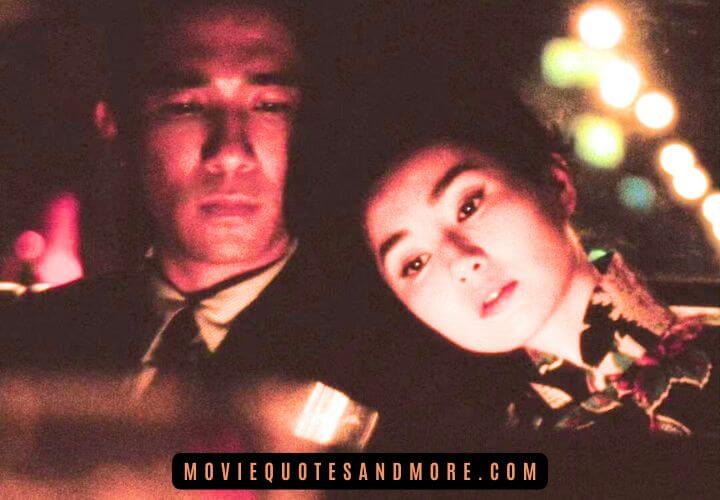
“It’s a restless moment. She has kept her head lowered… to give him a chance to come closer. But he could not for lack of courage. She turns and walks away.” The epigraph displayed at the beginning of Wong Kar-Wai’s In the Mood for Love (2000) summarizes the story of the two main characters before the film even begins. Set in Hong Kong during the year 1962, the critically acclaimed film explores the intricacies of an extramarital affair between Mrs. Chan, and her new neighbor Mr. Chow.
Before In the Mood for Love, Wong Kar-Wai’s films Days of Being Wild (1990) and Chunking Express (1994) put him on the map as an exciting new filmmaker. Film scholar Stephen Teo once described Wong Kar-Wai’s work as “a series of interconnecting stories,” and In the Mood for Love is no exception. The film is a compilation of gestures and moments of a budding romance that is fueled by the desires of Mrs. Chan and Mr. Chow. There is often repetition of scenery, where the two are seen briefly passing each other to get noodles or to go to their respective apartments.
The spouses of the main characters are largely missing from the film to the point where their faces aren’t ever shown. When the two realize their spouses are having affairs, they try to understand how the affairs could have started. They do this by impersonating each other’s spouses. Throughout the story the two act out what they think their spouses would say, or eat what their spouse would order at a restaurant. Oftentimes the viewers are left to question whether the characters are role-playing or not. Besides the curiosity surrounding the affairs, the only thing that seems to bind them is writing a martial arts story for a newspaper. It can be argued that fiction is the only reason Mrs. Chan and Mr. Chow had a relationship. Due to the lack of substance, the relationship eventually ends when Mr. Chow decides to travel to Singapore for work. During this point of the film, the two rehearse the end of their own affair in the same way the two would act as each other’s spouses. During the film’s coda, Mrs. Chan and Mr. Chow are seen just missing each other in Singapore and Hong Kong a few years later.
One of the most fascinating aspects of Mrs. Chan and Mr. Chow’s relationship is the level of intimacy that is created without the pair acting on their feelings for each other. Throughout the film, the two are never seen sharing a kiss or a sexual moment. Mr. Chow doesn’t even acknowledge his feelings for Mrs. Chan until announcing his departure to Singapore. Although the audience can tell that the two care for one another, there is a level of paranoia that infiltrates their romanticized relationship. The two act incredibly sneaky even though they aren’t in a sexual relationship. At one point during the film, the two skip work because they are afraid their other neighbors would suspect something if the pair were seen leaving the same room.
The cinematography of In the Mood for Love reflects the intricate relationship between Mrs. Chan and Mr. Chow. One of Wong Kar-Wai’s biggest inspirations for the film was Alfred Hitchcock’s Vertigo (1958), which is most apparent in the saturation of color that can be seen throughout the film. The colors red and green are heavily used to convey feelings of passion and jealousy between the two. The framing of the scenes often reflects feelings that the characters are too afraid to admit out loud. Mrs. Chan and Mr. Chow are often filmed through objects to create a sense of being watched. This helps further emphasize the feelings of paranoia between the two. The pacing of the film mirrors the fleeting feeling the characters are left with after they part ways. The structure of the film resembles a memory in which only the important parts of the narrative are highlighted, and the rest is largely forgotten.
Similar to the cinematography, the music in the film In the Mood for Love largely affects how the film is perceived by the audience. The soundtrack includes a diverse range of romantic songs in different languages with the same overarching feeling of melancholy. Although each song is used for specific reasons throughout the film, “Yumeji’s Theme” by Shigeru Umebayashi is the most memorable due to the number of times the song is repeated throughout the film. “Yumeji’s Theme” serves as a musical motif throughout the storyline that emphasizes a subdued, yet hypnotic, sense of longing. The distinct song is introduced five minutes into the film and is repeated during montages until the two characters part ways during their rehearsed affair ending. “Yumeji’s Theme” is reused during the film’s end credits, which helps viewers digest the overall theme of the film.
This film requires patience. From an American perspective, films are often expected to have grand gestures and moments for the audience to look forward to. In the Mood for Love skips over the climax or action of the film, and seemingly goes straight to the resolution. The anticipation of action only results in a disappointing end. While this might be seen as frustrating to some, I find it refreshingly realistic. This film highlights how desire can result in the romanization of a person. Loneliness fuels us to change our perceptions of those around us, and we end up molding someone into our ideal partner. American films often portray this romanticized pursuit as a fruitful one, however, that is rarely the case.
When comparing Wong Kar-Wai’s film to typical Hollywood films, there is a noticeable shift in subject matter which makes In the Mood for Love distinctly unique. Oftentimes, the primary focus of films that explore extramarital affairs are the adulterers themselves. However, in In the Mood for Love, the actual adulterers are absent from the film. Instead, Kar-Wai focuses on the victims of the affair, and the coping mechanisms they explore to help grieve over the unfaithfulness of their partners.